
A new short video found at the website for Minerals Make Life – a National Mining Association initiative – illuminates the close ties between the widespread resurgence of manufacturing in the United States and the need for stable access to mineral resources. As manufacturing experiences a resurgence in the United States, an expected 2 to

New Information on Demand for Rare Earths Demonstrates Need to Increase Efficiency in U.S. Mining Permitting Processes
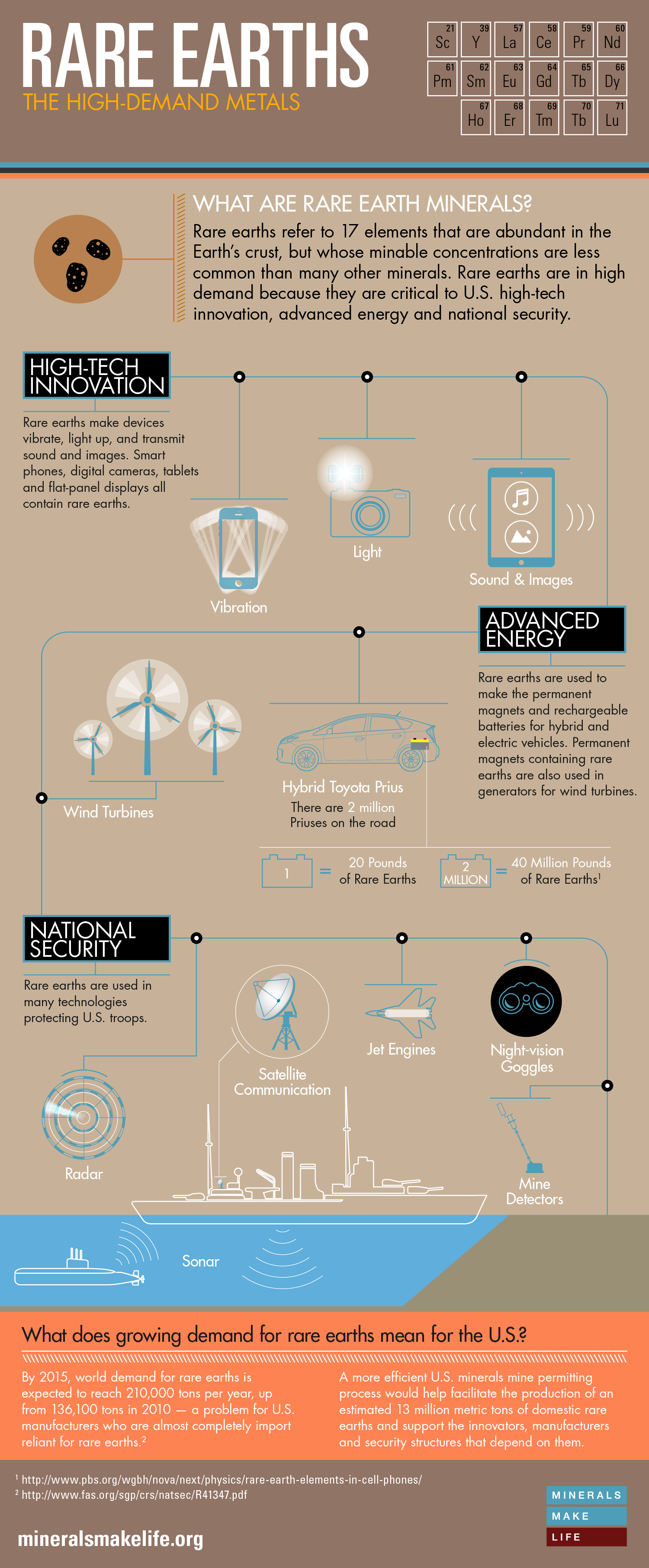
Minerals Make Life – a national, non-profit mining association – has recently developed an illuminating infographic indicating the increased demand for rare earth minerals. Presence of these minerals in the earth’s crust is common, but much less common in terms of minable concentrations. While demand for rare earths is rising, the current state of U.S.
BREAKING: California’s New General Industrial Storm Water Permit Will Impact Oil, Gas, and Mining Industries
Today, the State Water Resources Control Board (State Board) released for public comment its Draft Industrial Storm Water Permit and supporting documents. This is the fourth (and likely final) version of the Draft Industrial Storm Water Permit, which is designed to replace the existing Industrial Storm Water Permit in place since 1997.
The Draft
Senator Landrieu Ready to Take Chair’s Gavel on Powerful Senate Energy Committee: A Positive Outcome for the Oil and Gas Industry
Senator Mary Landrieu (D-LA) has confirmed today that she will take the position as Chair of the Senate Energy and Natural Resources Committee as soon as next week. (See previous post dated December 31, 3013.)
The previous chairman – Senator Ron Wyden (D-OR) – is expected to be approved as Chair of the Finance Committee
The Heat’s Still On! – Offshore Operators Must Disclose Hydraulic Fracturing Fluid Chemicals
The Environmental Protection Agency (“EPA”) announced that starting on March 1, 2014, oil and gas operators performing offshore hydraulic fracturing operations must maintain an inventory of chemicals used to formulate frac fluid, and if there is any discharge of that fluid, to include the chemical formulation to the EPA within a quarterly discharge monitoring report.
These new
Department of Conservation Deputy Director Jason Marshall Will Speak at Seminar on What To Expect from SB 4
On December 11, 2013, Stoel Rives and BSK Associates will host a complimentary breakfast seminar in Bakersfield, CA to share observations and strategies for complying with SB 4. Breakfast will begin at 7:30 a.m., with the program beginning at 8:00 a.m.
The office of Jason Marshall, Deputy Director of the Department of Conservation, has confirmed
The Real Cost of Doing Business – Fracking Industry May Feel a Big Hit from OSHA’s Proposed Silica Exposure Rule
In early September, OSHA issued a proposed rule that will limit permissible exposure to 50 micrograms of respirable crystalline silica per cubic meter of air. (See September 9, 2013 post.) This is approximately half of the current limit observed by industry. According to the U.S. Geological Survey, silica sand is used in approximately
A Tale of Two Pipelines: This Week in the News
It was the best of times, it was the worst of times…for two pipeline projects in the West.
TransCanada was successful in the Tenth Circuit on Thursday in its continuing efforts to defend against a preliminary injunction brought by the Sierra Club, Clean Energy Future of Oklahoma, and the East Texas Sub Regional Planning Commission.
New Study Shows Methane Emissions at Natural Gas Production Sites Are Less Than Previously Estimated
The Proceedings of the National Academy of Sciences recently published a study of direct measurements of methane emissions from sources at 190 onshore natural gas production sites using operational practices. The estimate of total emissions from this study is similar to the Environmental Protection Agency’s (EPA) recent National Emissions Inventory of methane emissions from natural
Train Explosion Drives Federal Railroad Administration to Issue New Regulations Impacting the Transportation of Petroleum Products
On August 2, 2013 the Federal Railroad Administration (“FRA”) released Emergency Order No. 28, Notice No. 1 and Safety Advisory 2013-06 in response to the July 2013 tragedy in Lac-Mégantic, Quebec, Canada where a cargo train derailed, exploding portions of the 72 cars of petroleum crude oil it carried. The explosion killed 47 people and