On Friday, July 11, 2014 the U.S. Environmental Protection Agency (“USEPA”) extended the public comment period for its advanced notice of proposed rulemaking (“ANPR”) for hydraulic fracturing chemical disclosure rules. The USEPA initially requested public comment on May 9, 2014 by issuing the ANPR. This set a 90-day public comment period, slated to end on
Water Board Announces Meeting to Develop SB 4 Groundwater Monitoring Criteria
On Wednesday, July 9, 2014, the State Water Resources Control Board (“Water Board”) announced that it will be holding a “Stakeholder Meeting to Develop Groundwater Monitoring Model Criteria for Oil & Gas Areas.” The meeting is scheduled for Thursday, August 7, 2014 from 8:00 am to 5:00 pm in the Kern County Supervisors Chambers in Bakersfield. The Water Board is required to develop model groundwater monitoring criteria by July 1, 2015 pursuant to Senate Bill 4 (“SB 4”). (Wat. Code, § 10783, subd. (c).)
Interim well stimulation regulations, issued by the Department of Conservation’s Division of Oil, Gas & Geothermal Resources (“DOGGR”) came into effect on January 1, 2014. DOGGR is on schedule to publish permanent regulations on January 1, 2015. Under the interim regulations, well operators must submit a groundwater monitoring plan, or request an exemption from the Water Board if the operator can show the absence of protected waters. (Interim Regulations, § 1783.1, subd. (b)(4).) If the exemption is granted, the Water Board issues a written concurrence. (§ 1783.4, subd. (c).)Continue Reading Water Board Announces Meeting to Develop SB 4 Groundwater Monitoring Criteria
With Increased Federal Scrutiny, State Governments Look To Expand Oil-By-Rail Oversight
With the federal Department of Transportation’s recent emergency order impacting those who transport crude oil by rail, state governments are likewise considering additional regulatory oversight that could affect the industry in the wake of recent train derailments such as the one yesterday in Virginia.
In Minnesota, where more than 800 tank cars carrying oil…
Construction Aggregate Production Rebounds in California; Gold Production Declines
On April 29th, the California Geological Survey (CGS) released production data from 2012 indicating that the production of construction aggregate (sand, gravel and crushed stone) increased for the first time since 2007 in California. Construction aggregate production increased by 7.3 percent to 121.3 million tons (valued at $1.162 billion). Portland cement production also increased by…
Baker Hughes’ Policy to Disclose Chemical Components in Well Stimulation Fluids Designed to “Increase the Public Trust”
One of the largest oil-field services companies in the world, Baker Hughes, has revised its long-standing policies on disclosing the contents of hydraulic fracturing fluids on FracFocus.org – a non-profit database designed to provide the public with information related to oil and gas development.
The policy states that the company believes it is “possible to…
A Resurgence in U.S. Manufacturing Requires a Sensible Mining Permitting Process
A new short video found at the website for Minerals Make Life – a National Mining Association initiative – illuminates the close ties between the widespread resurgence of manufacturing in the United States and the need for stable access to mineral resources. As manufacturing experiences a resurgence in the United States, an expected 2 to…
Study Suggests EPA Underestimated Natural Gas Methane Emissions, But Not for Fracking, and EPA Releases Study Examining Fracking Emissions Controls
In several recent studies on methane emissions relating to the natural gas industry, scientists concluded that the U.S. Environmental Protection Agency (EPA) underestimated the quantity of methane the industry releases to the atmosphere. A study released Monday, based on air samples above wells in the Marcellus Shale formation in Pennsylvania, indicates that methane emissions may be from 100 to 1000 times higher than EPA estimates. But this study also found that hydraulic fracturing was not a primary source of methane emissions.
Also this week, EPA released five white papers for peer review identifying fracking, along with compressors, leaks, liquids unloading and pneumatic devices, as a potentially significant source of methane and volatile organic compound (VOC) emissions. The papers are the first step in President Obama’s Climate Action Plan Strategy to Reduce Methane Emissions targeting several areas, including the oil and gas sector, for reducing methane emissions.
Continue Reading Study Suggests EPA Underestimated Natural Gas Methane Emissions, But Not for Fracking, and EPA Releases Study Examining Fracking Emissions Controls
New Information on Demand for Rare Earths Demonstrates Need to Increase Efficiency in U.S. Mining Permitting Processes
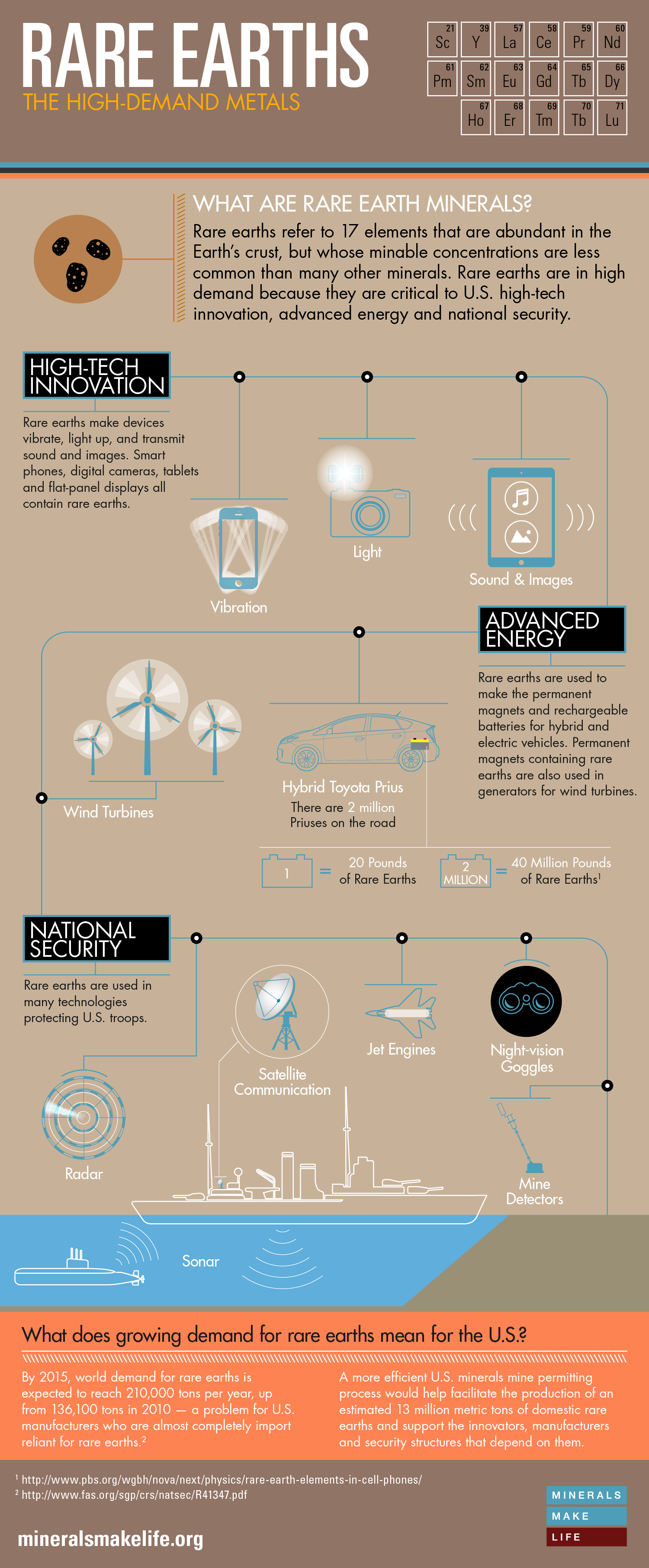
Minerals Make Life – a national, non-profit mining association – has recently developed an illuminating infographic indicating the increased demand for rare earth minerals. Presence of these minerals in the earth’s crust is common, but much less common in terms of minable concentrations. While demand for rare earths is rising, the current state of U.S.
Debates Continue Over Taxes And Fees On Hydraulic Fracturing In Ohio And Pennsylvania
In exchange for a $2.6 billion cut to Ohio’s state income taxes, Gov. John Kasich has proposed a package of tax increases in other areas. Included among those increases would be the gradual implementation of a 2.75 percent tax on oil and gas extracted through horizontal drilling and hydraulic fracturing in Ohio, which is estimated…
Minnesota Environmental Quality Board Approves Model Standards For Local Silica Sand Mining Regulations
On March 19, the Minnesota Environmental Quality Board (EQB) approved its proposed model standards for local silica sand mining regulations and planning. The standards are intended to serve as guidelines for city and county governments as they work to develop their own local ordinances for mining, processing, and transporting silica sand. The Minnesota Legislature mandated…