
A new short video found at the website for Minerals Make Life – a National Mining Association initiative – illuminates the close ties between the widespread resurgence of manufacturing in the United States and the need for stable access to mineral resources. As manufacturing experiences a resurgence in the United States, an expected 2 to
Mining
New Information on Demand for Rare Earths Demonstrates Need to Increase Efficiency in U.S. Mining Permitting Processes
By Mike Mills on
Posted in Mining, Permitting
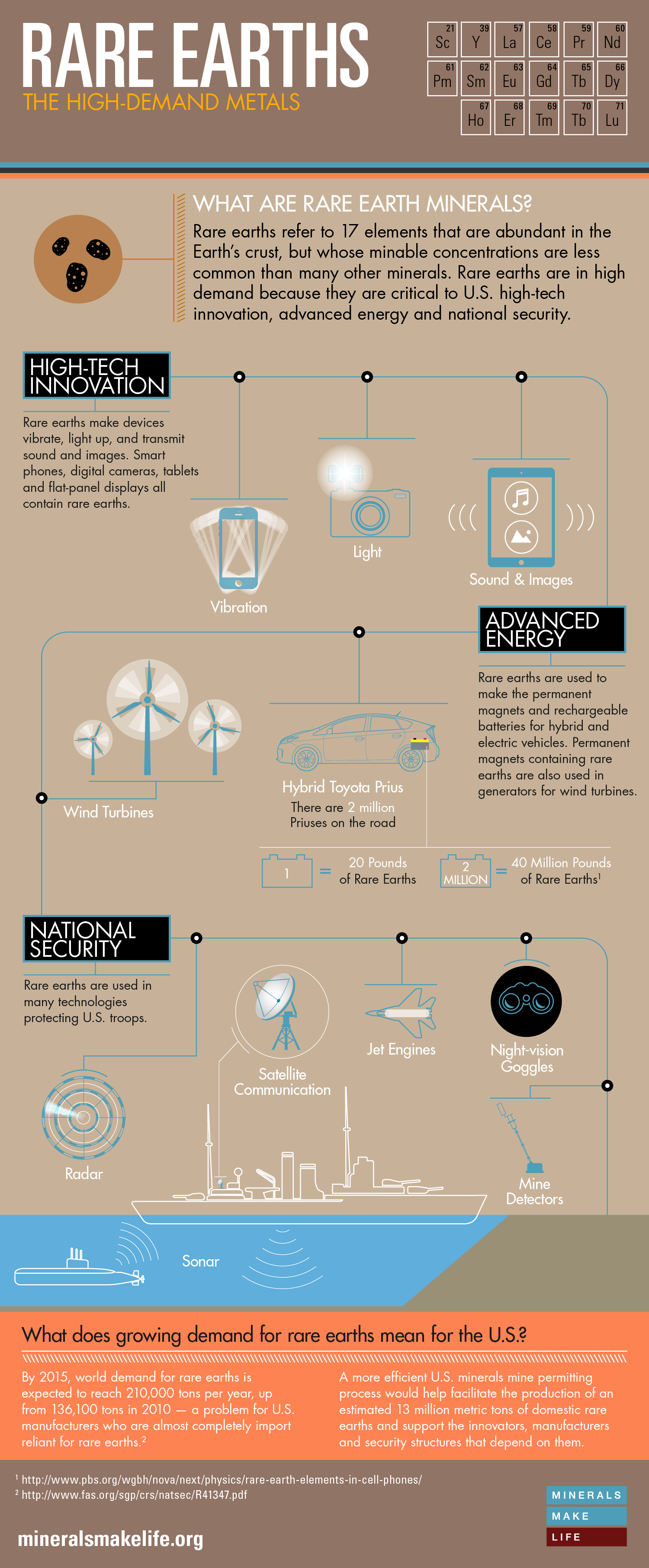
Minerals Make Life – a national, non-profit mining association – has recently developed an illuminating infographic indicating the increased demand for rare earth minerals. Presence of these minerals in the earth’s crust is common, but much less common in terms of minable concentrations. While demand for rare earths is rising, the current state of U.S.
Minnesota Environmental Quality Board Approves Model Standards For Local Silica Sand Mining Regulations
By Andrew Pieper on
On March 19, the Minnesota Environmental Quality Board (EQB) approved its proposed model standards for local silica sand mining regulations and planning. The standards are intended to serve as guidelines for city and county governments as they work to develop their own local ordinances for mining, processing, and transporting silica sand. The Minnesota Legislature mandated…
BREAKING: California’s New General Industrial Storm Water Permit Will Impact Oil, Gas, and Mining Industries
By Mike Mills on
Today, the State Water Resources Control Board (State Board) released for public comment its Draft Industrial Storm Water Permit and supporting documents. This is the fourth (and likely final) version of the Draft Industrial Storm Water Permit, which is designed to replace the existing Industrial Storm Water Permit in place since 1997.
The Draft…
Draft Of Model Silica Sand Mining Regulations Released By Minnesota Environmental Quality Board
By Andrew Pieper on
Update: The Minnesota Environmental Quality Board extended the public comment period for the draft model guidelines by two weeks. The deadline for public comments is now January 27.
On December 13, the Minnesota Environmental Quality Board (EQB) – in collaboration with several other state agencies, including the Minnesota Department of Natural Resources (DNR) and…
Proposed Sage-Grouse Protections May Impact Mining Along the California-Nevada Border
By Michael Sherman on
Via my colleagues Barbara Craig, Ryan Steen and Sarah Stauffer Curtiss:
On October 28, 2013, the U.S. Fish and Wildlife Service (“USFWS”) proposed to list the Bi-State distinct population segment (“Bi-State DPS”) of greater sage-grouse (Centrocercus urophasianus) as a threatened species under the Endangered Species Act (“ESA”) and to designate critical…
Leniency for California Miners — And a Call for “Top to Bottom” Reform of California Surface Mining Law
By Michael Sherman on
California Governor Jerry Brown signed SB 447 on Saturday, September 28, 2013, which modifies the Office of Mine Reclamation’s (OMR) authority to list or delist a mine from its list of “good mines” under Cal. Public Resources Code Section 2717 (more commonly referred to as the AB 3098 List). Mines on the AB 3098…
Oregon Mining Operations Benefit from New Sage Grouse Habitat Law
By Jerry Fish on
Over 40 percent of the lands in Malheur County have been designated as core habitat for sage grouse by the Oregon Department of Fish and Wildlife (“ODFW”). Other counties in southeastern Oregon are also heavily affected. ODFW’s approach was to simply recommend against any development in core habitat, without consideration whether off-site mitigation could result…
Please Note: BLM Oregon/Washington State Office Has Relocated
By Bill Rodgers on
Readers please note that the Oregon/Washington State Office of the Bureau of Land Management has relocated, effective today. The new address is the Edith Green-Wendell Wyatt Federal Building at 1220 SW 3rd Avenue, Portland, OR 97204. The mailing address and telephone number remain the same: P.O. Box 2965, Portland, OR 97208 and (503) 808-6001 (press…
BLM California State Office Cancels Statutorily-Required Oil & Gas Lease Auctions for 2013
By Mike Mills on
The third Bureau of Land Management auction of oil and gas sales scheduled for the 2013 fiscal year should have been held today for federal lands in California. However, last month the BLM California office issued a short notice stating that it would cancel remaining 2013 oil and gas lease sales planned for May, June…